Flat 50% OFF sitewide!
NOW & ON BLACK FRIDAY!




9ct Vs. 18ct Gold: What’s The Difference And Which Is Better?
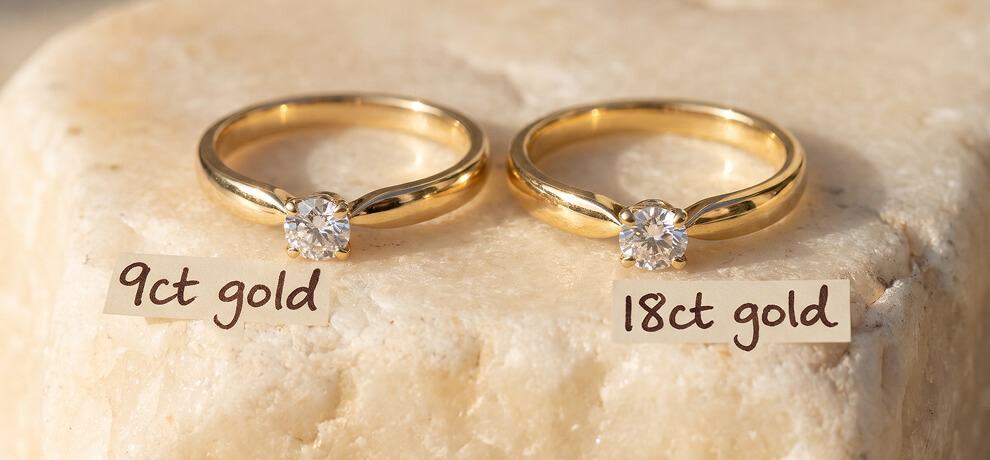
The choice between 9ct and 18ct gold influences how the piece looks, its durability, cost, and how much maintenance it will require over the years. The fundamental issue is the amount of gold. 9ct gold is made up of 37.5% pure gold, whereas 18ct gold is 75% pure. Still, more gold does not always mean increased resilience or performance of a piece of jewellery.
Understanding the difference between 9ct and 18ct gold will assist in your choice in what type of jewellery to buy, such as an engagement or wedding ring or everyday jewellery. Here's how each one compares.
Table of Content
- What is 9ct Gold?
- What is 18ct Gold?
- What Do the 375 and 750 UK Gold Hallmarks Mean?
- 9ct vs. 18ct Gold Comparison
- What Are the Differences Between 9ct and 18ct Gold?
- A Closer Look at 9ct and 18ct in White, Yellow, and Rose Gold
- What Is the Price Difference Between 9ct and 18ct Gold?
- What Are the Pros and Cons of 9ct and 18ct Gold?
- Which One Is Better for Everyday Wear?
- How to Choose Between 9ct and 18ct Gold?
What is 9ct Gold?
In 9ct gold, there are 9 parts pure gold, along with 15 parts of metal alloy, in 24 total parts. This gives it a gold purity of 37.5%, which is denoted by the British hallmark 375. Other ingredients, making up 62.5% of the jewellery piece, include alloy metals, including copper, silver, and zinc. The percentage ratio differs based on the producer and the desired outcome of the piece.
Compared to 18ct gold, there is less gold present in it. As a result, it usually comes at a lower price, and its alloy content may be harder than that of other high-carat gold pieces, depending on the combination. Yellow, white, and rose 9ct gold jewellery is widely sought after among buyers looking to buy gold at a lower price.
What is 18ct Gold?
18ct gold is composed of 18 parts gold and six parts other metals, making the gold content of 18ct gold equal to 75%. The hallmark of 18ct gold in the UK is 750. The higher gold content normally makes 18ct yellow gold appear more luxurious and warm. It is also less likely to tarnish and oxidise compared to lower carats of gold.
The other 25% of the composition includes alloy metals, which determine the final colour, hardness, and workability of the metal. 18ct gold is widely used in fine jewellery, engagement rings, and wedding bands. It contains more precious metal than others, but it is more prone to scratching.
What Do the 375 and 750 UK Gold Hallmarks Mean?
The figures that appear on gold jewellery are the measures of their purity, expressed in parts per thousand.
-
375: No less than 375 parts gold per 1,000. In other words, 37.5 percent gold or 9 carats.
-
750: No less than 750 parts gold per 1,000. In other words, 75 percent gold or 18 carats
A standard UK hallmark usually consists of three marks, which are the sponsor's mark, metal/fineness mark, and Assay Office mark. However, a date letter is optional. Gold articles weighing less than one gram do not need a compulsory hallmark. This explains why a hallmark can be missing even though the item may be genuine.
9ct vs. 18ct Gold Comparison
|
Feature |
9ct Gold |
18ct Gold |
|
Purity of Gold |
37.5% |
75% |
|
UK Hallmark |
375 |
750 |
|
Colour |
Generally Pale |
Generally Rich |
|
Hardness |
Usually hard, depending on alloy |
Usually soft, depending on alloy |
|
Strength |
Dependent on alloy composition |
Usually more malleable and ductile |
|
Weight |
Depends on alloy and style |
Usually weighs more, given identical style |
|
Susceptibility to tarnish |
More likely |
More resistant |
|
Risk of allergic reaction |
Depends on alloy metals |
Depends on alloy metals |
|
Maintenance of rhodium |
Needed if rhodium-coated |
Needed if rhodium-coated |
|
Costs |
Usually lower |
Usually higher |
|
Value of gold |
Lower |
Higher |
|
Best application for |
Everyday jewellery |
Higher-quality jewellery |
What Are the Differences Between 9ct and 18ct Gold?
The difference between 9ct and 18ct gold is not limited to the gold content of each alloy. It may affect such characteristics of the jewellery as colour, hardness of the surface, weight, maintenance and total price. All these differences should be considered when choosing a gold caratage, especially if you plan to wear it often.
Colour
The gold content greatly affects the colour of yellow gold. The choice between 9ct and 18ct gold, in this case, is the choice between light and rich yellow. 18ct yellow gold will be richer in colour because it has more pure gold. 9ct yellow gold will be lighter because it has less pure gold and more alloy metals.
However, the shade will also depend on the type of alloy metals. This means that even the jewellery of the same carat may have different shades.
Durability: Hardness vs. Toughness
Durability of both 9ct and 18ct gold involves factors other than the purity of gold. The difference between hardness and toughness of an alloy gives a clearer insight into how they perform.
-
Hardness means resistance to scratching and indentations on the surface. Some 9ct gold alloys are harder than 18ct alloys and thus more durable against surface scratches.
-
Toughness refers to resistance to cracking and breakage. 18ct gold is more malleable and ductile. It bends and twists comparatively easily, and some 9ct gold alloys might be more brittle
It is an important factor when considering engagement rings with diamond settings. An 18ct gold setting is reliable enough, but just high caratage does not necessarily mean that the claws hold the diamond better. Thickness and construction of claws, composition of alloys, and workmanship matter. Both kinds of gold alloys may get scratched or damaged. Rings with stone settings should be examined regularly regardless of caratage.
Weight
The weight of 9ct and 18ct gold jewellery varies according to the density of the alloy as well as the dimensions of the piece of jewellery. 18ct gold is usually more dense than 9ct gold, which means that two rings with the same design and dimensions may not weigh the same. This becomes more apparent when the items in question are wide wedding bands, heavy rings and large bracelets.
If you prefer lighter jewellery, check the exact weight in grams of each piece and not only its carat number.
Tarnish
Gold does not corrode easily; however, other metals in the gold alloy can react to water, air, and chemicals. As 9ct gold consists of a smaller percentage of pure gold, it tends to tarnish or change its colour more easily. 18ct gold maintains its look because of a larger proportion of gold in its alloy composition.
Both types of gold require regular cleaning and taking off your gold jewellery before using cleaning products, going for a swim, and applying make-up.
Skin Sensitivity and Allergies
Since the metal composition of 9ct gold and 18ct gold is different, it influences the chance of developing an allergic reaction. The higher ratio of other metals in 9ct gold makes it more likely that there will be more metals causing a skin reaction.
Nickel is one of the most common causes of allergies in jewellery. Nevertheless, there can be a reaction to other types of metals too. The caratage does not necessarily mean that a piece of jewellery will not irritate the skin.
If you suffer from metal allergies, make sure you read the alloy information provided by the manufacturer. There are also regulations in place in the UK, restricting the amount of nickel in products meant to be worn on the skin.
Price and Value
As opposed to the question "what is the difference between 9ct and 18ct gold?" The answer to "how much does 18ct gold cost compared to 9ct gold" is quite obvious and depends mainly on metal value. 18ct gold has twice the ratio of gold as 9ct gold. Nevertheless, gold is not the only reason for the price of a ring.
A Closer Look at 9ct and 18ct in White, Yellow, and Rose Gold
Though both caratages are available in all three common types of gold, the difference in alloy composition results in different finishes.
-
Yellow gold: Generally, 18ct yellow gold looks more rich and warm compared to 9ct yellow gold that appears paler.
-
White gold: 9ct and 18ct white gold both contain gold alloyed with metals that give the colour of white. Rhodium plating is usually done to make white gold appear more brilliant. However, since the layer fades away over time, you will need to get your piece re-plated periodically.
-
Rose gold: The pinkish hue of rose gold is achieved by alloying gold with copper metal. The 9ct alloy of rose gold usually contains more copper metal compared to 18ct rose gold, hence the stronger red or pink finish. It is dependent on the formula of the alloy
When looking for a brilliant white piece, take into account the maintenance needs of the rhodium-plated white gold. In addition, the difference in the alloy metals when choosing 9ct vs. 18ct white gold should be considered.
What Is the Price Difference between 9ct and 18ct Gold?
The 9ct to 18ct gold price difference varies depending on the value of the gold itself as well as the cost of the jewellery piece. Because there is double the amount of gold in 18ct than there is in 9ct, it has a higher intrinsic metal value.
Ring Price Comparison of 9ct and 18ct Gold
A direct comparison can be made with the Claire full eternity lab diamond ring offered by Friendly Diamonds. The two rings have identical settings, featuring a 5.00 ct radiant centre diamond and EF-VS1+ quality in white gold.
|
Ring specifications |
9ct White Gold |
18ct White Gold |
|
Ring |
Claire Full Eternity |
Claire Full Eternity |
|
Centre Diamond |
5.00 ct radiant |
5.00 ct radiant |
|
Diamond Quality |
EF-VS1+ |
EF-VS1+ |
|
Price |
£2,165 |
£2,800 |
The 18ct piece is more expensive by £635 compared to the 9ct piece, 29% more expensive. These prices are indicative as promotional prices and subject to change according to the retailer's offer.
Gold price in the UK per gram
For a different type of comparison of the value of the material, the price of gold in the UK on 5 November 2026 was:
|
Gold purity |
Indicative price per gram |
|
9ct gold |
£36.98 |
|
18ct gold |
£73.95 |
These are indicative gold prices per gram and not the retail price of the jewellery. Production costs, design, precious stones, and the retailer's margin are additional expenses. The gold price varies as well, and therefore these are the historical price indicators.
To make a proper comparison between 9ct and 18ct gold prices, one needs to consider both the gold price and the jewellery price.
What Are the Pros and Cons of 9ct and 18ct Gold?
Both have good and bad points. 9ct gold is affordable and scratches less easily. 18ct gold has a richer colour, tarnishes less, and lasts longer over time. Here’s a quick look at each so you can choose what suits your budget and how often you’ll wear it.
9ct Gold
Pros:
-
Affordable to buy compared to 18ct gold.
-
May be less susceptible to scratching.
-
Available in yellow, white, or rose gold.
-
Suitable for wearing everyday jewellery when designed and maintained properly
Cons:
-
Has lower purity of gold.
-
Susceptible to tarnishing.
-
Some of the alloys may be less flexible.
-
Greater chances of alloy metal reactions.
18ct Gold
Pros:
-
Composed of 75% pure gold.
-
Deeper colour, especially yellow gold.
-
Tarnish-resistant generally.
-
Higher amount of pure gold, hence higher in value.
-
Easier to shape or mould
Cons:
-
Costly to buy.
-
Prone to scratches easily.
-
Still needs cleaning from time to time.
-
Rhodium plating is often needed with white gold.
Which One Is Better for Everyday Wear?
9ct gold and 18ct gold are equally suitable for everyday wear. The choice depends on your lifestyle, cost concerns, and the kind of jewellery you plan to wear.
-
9ct gold may be considered more practical for everyday rings and bands if you want a lower price and a harder surface on the jewellery. The scratch-resistant property doesn't mean that 9ct gold cannot crack or break
-
If you like golden colour, higher gold content, and a softer alloy, 18ct gold may be a good choice for you. It will have a tendency to scratch easily, but it doesn't necessarily mean that it cannot be worn every day
Regardless of your choice, it is recommended to take off rings when performing activities that may cause a strong impact on your jewellery.
Which Is Better for Engagement Rings and Wedding Bands?
Engagement rings usually have high settings, fine claws, and diamonds that require reliable support. Both 9ct and 18ct gold can be used; however, the design and manufacturing of the setting play an especially important role.
As far as diamond engagement rings are concerned, 18ct gold has a high content of precious metal and high malleability. However, its wearability also depends on the shape and size of claws. Ask about the manufacturing process of the setting instead of just considering caratage.
As far as wedding bands are concerned, 9ct gold can be a cost-effective choice while 18ct gold is preferred by people who prefer darker colour and high content of gold.
If you are planning to wear both an engagement ring and a wedding band, it makes sense to make sure that they match each other in terms of carat and gold colour. It is also possible to mix 9ct and 18ct gold; however, some colour and wear differences may be noticeable.
How to Choose Between 9ct and 18ct Gold?
Just use this checklist when making your selection:
-
Budget: Select 9ct if you wish to own some real gold jewellery but are concerned about a high starting price tag. Go for 18ct if you do not mind spending a bit more.
-
Lifestyle: Take into account the extent to which you plan on wearing it and what sort of physical wear it would have to endure. 9ct resists surface scratches better, while 18ct is tougher and less likely to crack and is a good choice for everyday wear jewellery.
-
Metal sensitivity: If you have sensitive skin, 18ct may lower the risk because it contains less alloy, but it isn’t hypoallergenic.
-
Nature of the jewellery: Opt for 18ct if you are looking for fine jewellery and engagement rings, while choosing 9ct as an alternative for regular bands and budget-friendly pieces.
-
Finish: Go for 18ct if you prefer a richer yellow colour, or 9ct if you would like something with a lighter finish.
-
Value: Compare gold content, quality, and design rather than the purchase price alone
In the end, the right selection is based on your budget, appearance preference, and everyday wear expectations.
FAQs
Is 9ct gold real gold?
Is 9ct gold valuable?
Can you wear 9ct gold every day?
How long will a 9ct gold ring last?
Is 18ct gold worth the extra cost?
Does 9ct gold tarnish?
Is 18ct gold heavier than 9ct?
Can 9ct gold cause allergies?