Flat 50% OFF sitewide!
NOW & ON BLACK FRIDAY!





Do Lab-Grown Diamonds Pass a Diamond Tester?
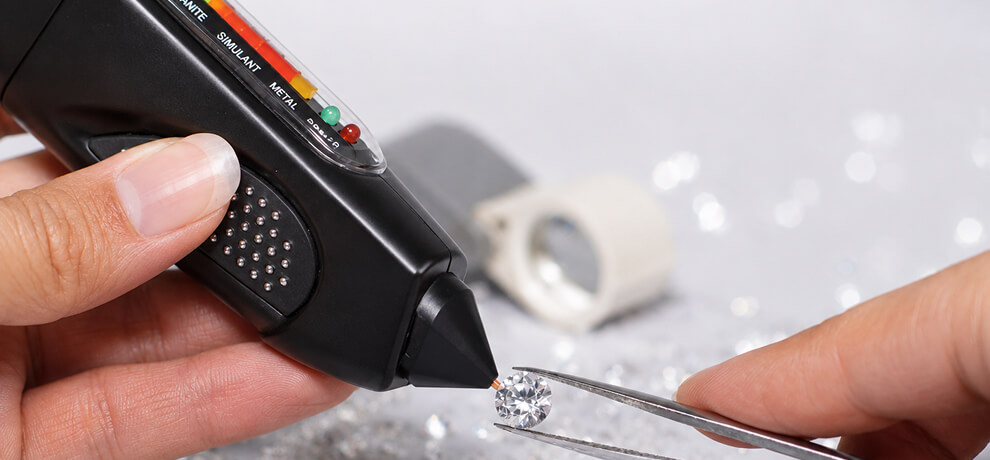
If you are looking for the short answer, then yes, lab-grown diamonds will pass the diamond tester tests. Lab-grown diamonds are actual diamonds with the same characteristics as natural diamonds. A thermal diamond tester will recognise them as diamonds, whereas an electrical or multi-tester may sometimes show an odd reading for certain lab-grown diamonds.
However, a positive result is not enough to tell whether a diamond has been grown in a laboratory or mined from nature. It needs special gemological tests. So if you are wondering whether lab-grown diamonds pass diamond tester tests and are looking for a clearer answer, this blog is for you. Let's understand how diamond testers function, how CVD and HPHT diamonds behave, why some lab diamonds test as moissanite, and how to check the origin of your diamond in the UK.
Table of Content
- How Does a Diamond Tester Work?
- Do Diamond Tests Work on Lab-Grown Diamonds?
- Do Lab-Grown Diamonds Test Real?
- Why Some Lab Diamonds Test as Moissanite
- What Results Do Diamond Testers Give for Different Stones?
- Can a Diamond Tester Tell if a Diamond Is Lab-Grown?
- How Do You Verify a Laboratory-Grown Diamond?
- Conclusion
How Does a Diamond Tester Work?
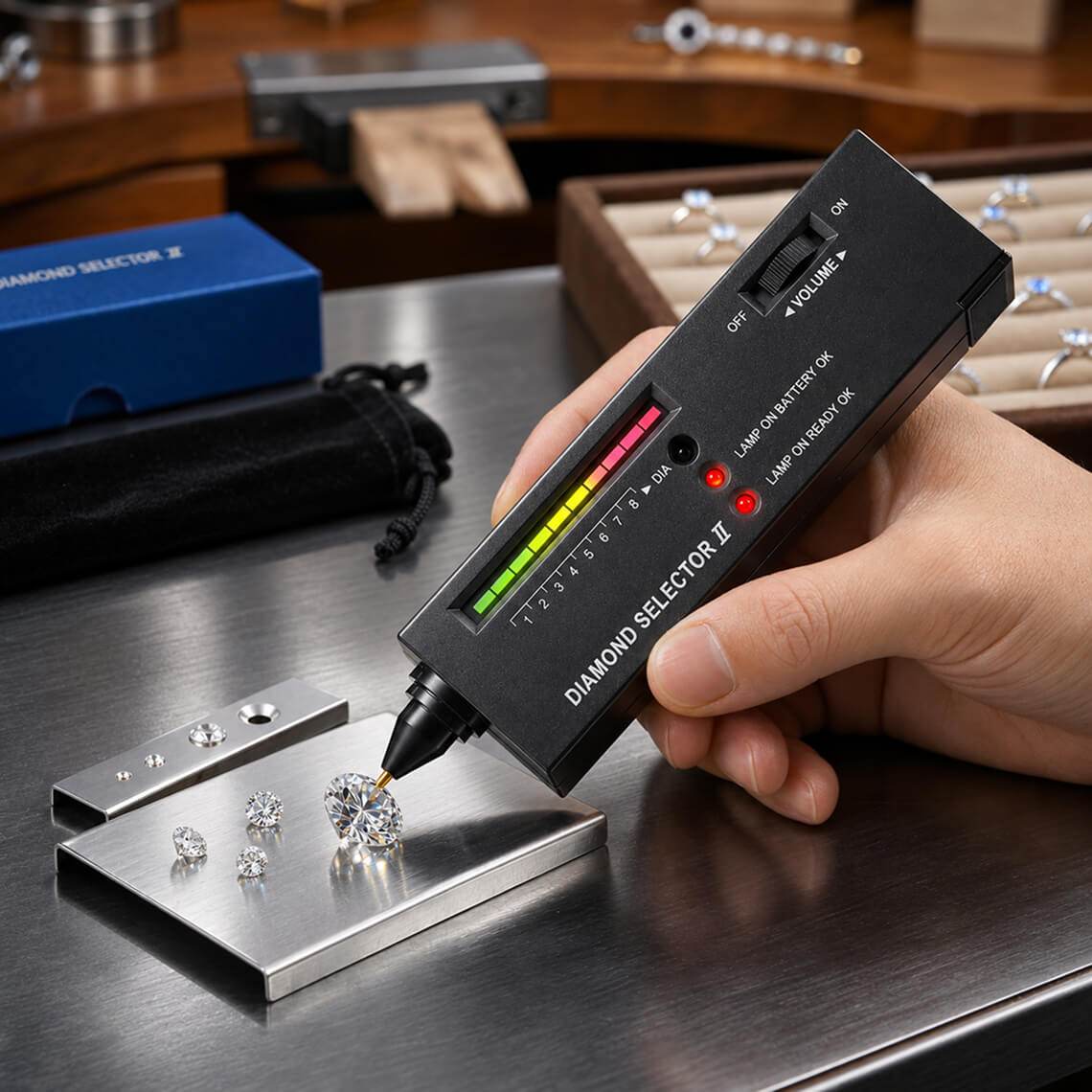
The diamond tester works by determining if the stone has the physical attributes that define a diamond. Most detectors test thermal conductivity, electrical conductivity, or both in order to differentiate a diamond from simulants such as cubic zirconia and moissanite. However, regular testers cannot differentiate between natural diamonds and lab-grown ones.
That explains why there are many questions surrounding whether a diamond tester detects lab-grown diamonds. The answer depends on the type of tester used.
Thermal Diamond Testers
Thermal diamond testers test the thermal conductivity of a stone, measuring how fast heat transfers through it. The gadget heats the probe of the tester, which is then pressed onto a precious stone. A tester gauges how fast heat is transferred away from a heated tip.
Diamonds have a very high thermal conductivity level. This is why both natural and lab-grown diamonds will give a positive result regarding a diamond. Moissanite also has high thermal conductivity, which means that moissanite might be identified as a diamond by a thermal diamond tester only.
Electrical Conductivity Testers
Electrical conductivity testers test the electrical conductivity of the stone. They help to distinguish moissanite from diamond because of their differences in electrical properties.
Most colourless diamonds are electrically insulating, while moissanite is semiconducting. But there are some diamonds that conduct electricity. Diamonds containing trace boron, whether natural or lab-grown, can conduct electricity. Boron is more common in HPHT lab-grown diamonds, and in rarer cases, metallic inclusions left after growth can also affect the reading.
As a result, there is a possibility of misreading the electrical tester on a lab-grown diamond as moissanite. This does not necessarily mean that the stone is an imitation.
Multi-Testers
Multi-testers use both thermal and electrical conductivity tests to make the difference between diamonds and simulants better.
An ordinary tester conducts a thermal test and then applies an electrical test to identify moissanite. It is more effective than a thermal tester when identifying diamonds or moissanite. But some HPHT diamonds still respond to electrical conductivity tests like moissanite, although they are real diamonds.
The critical difference: Lab-created diamonds usually pass the tests done by diamond testers, but standard handheld testers cannot reliably distinguish between a natural diamond and a lab-created one.
Do Diamond Tests Work on Lab-Grown Diamonds?
Yes, lab-created diamonds usually perform well on diamond tests since they have the same physical characteristics that natural diamonds possess. So, if you’re questioning whether lab-created diamonds pass diamond tests, CVD and HPHT diamonds usually yield a positive result when tested for thermal conductivity. Yet, the creation process may impact the electrical test results.
CVD Lab-Grown Diamonds
Chemical Vapour Deposition (CVD) is the process in which a carbon-containing gas is placed in a controlled environment. Carbon atoms start to deposit on the diamond seed and form a larger diamond crystal.
Since CVD diamonds possess all the basic features that are present in natural diamonds, including thermal conductivity, they usually result in the following:
-
Thermal tester: Identifies a CVD diamond as a diamond.
-
Electrical tester: Shows no conductivity, so it won’t read as moissanite.
-
Multi-tester: Usually identifies it as a diamond, but the result is not a guarantee of its origin.
CVD diamonds are grown without a metal catalyst and rarely contain boron, so they don’t usually conduct electricity. Nevertheless, every stone can have different features, and thus, an unusual reaction cannot be used to prove the origin of the stone.
HPHT Lab-Grown Diamonds
High Pressure High Temperature (HPHT) is also one of the means of producing diamonds. The conditions of high temperature and pressure typical of natural diamond formation are recreated using special equipment.
The carbon is put under pressure and heated, which allows it to crystallise around a diamond seed. Metallic catalysts are used in this process. HPHT diamonds typically react positively in thermal diamond testers, similar to natural diamonds. However, some HPHT diamonds contain trace boron, or occasionally metallic inclusions, which can affect electrical conductivity.
This leads to the following reaction:
-
Thermal tester: Identifies the stone as a diamond.
-
Electrical tester: Sometimes gives a moissanite-like reaction.
-
Multi-tester: Usually reads as diamond, but may indicate some HPHT diamonds as moissanite.
This does not mean that HPHT diamonds are fake compared to CVD diamonds. They are both genuine diamonds; only the methods of production differ.
Do Lab Grown Diamonds Test Real?
Yes. Lab-grown diamonds test real because they consist of carbon atoms bonded in the same crystal structure as natural diamonds. The difference lies in their origin, but the essential properties of chemistry, optics, and physics are the same. This is why thermal detectors classify both types of stones as diamonds and not simulants.
It is crucial to tell apart a lab-grown diamond from other materials, like cubic zirconia and moissanite, which might look like diamonds but have a different composition and physical properties. To learn more about the science of their authenticity, see our guide on whether lab-grown diamonds are real.
Why Some Lab Diamonds Test as Moissanite
The most frequent question asked by consumers is: can a diamond tester detect lab-grown diamonds when an electrical device sometimes identifies them as moissanite? The answer is no. It doesn't necessarily mean that the lab diamond is a fake one. This situation occurs if the electrical tester recognises conductivity within the stone.
Electrical tests may be performed incorrectly in cases where HPHT diamonds have metallic impurities left after the growth process. Also, some diamonds that have boron may conduct electricity. For that reason, certain electrical testers might confuse those diamonds with moissanite because of conductivity.
Here is what every buyer needs to know:
-
Thermal tester: May confuse moissanite and diamond since their thermal reactions are similar.
-
Electrical tester: May sometimes confuse certain real diamonds for moissanite.
-
Multi-tester: Eliminates certain testing mistakes but cannot prove the origin of the stone, i.e., whether it is natural or lab-created.
In case a certified lab diamond is read as moissanite, don't assume that the grading certificate is wrong. You need to check your stone and its documentation at the gemological laboratory.
What Results Do Diamond Testers Give for Different Stones?
A variety of stones can produce varying readings based on the testing equipment used. The chart below shows how each type of diamond is read using these testers.
|
Stone |
Thermal Tester |
Electrical Tester |
Multi-Tester |
|
Natural diamond |
Diamond |
Not conductive |
Usually diamond |
|
CVD lab-grown diamond |
Diamond |
Not conductive |
Diamond usually |
|
HPHT Lab-Grown Diamond |
Diamond |
Usually not conductive; some read as moissanite |
Usually diamond; some read as moissanite |
|
Moissanite |
Reads as diamond |
Is generally moissanite |
Is generally moissanite |
|
Cubic zirconia (CZ) |
Normally simulant |
Not conductive (doesn’t read as moissanite) |
Normally simulant |
Keep in mind that this may not necessarily be the case for all diamonds or testers. The nature of the diamond, its electrical properties, tester design, and testing environment will determine this result. This explains why a tester would just serve as a first-step identification process. A "positive" reading on a diamond does not tell you anything about the origin of the stone or if it is lab-grown or not.
Can a Diamond Tester Tell if a Diamond Is Lab-Grown?
No, a regular diamond tester is unable to tell the difference between a natural and a lab-grown diamond because both of them have similar physical properties that the hand-held device tests.
In order to determine whether a diamond is a lab-grown diamond or not, specialists use specialised screening devices and gemmology laboratories that examine particular properties that were formed during the process of the stone's formation.
Lab-Grown Screening Devices
There are special screening devices that test the optical and growth properties of a diamond in order to detect whether the stone is a lab-grown one. Some screening devices use ultraviolet light to test the fluorescence pattern of the stone, while some screeners check the reaction of the stone to light.
Screening device results can be either pass or refer. In the case of the latter result, this means that the stone requires further examination, but does not mean that it is lab-grown.
Gem Lab Tests
Even though the customer might want to know if a diamond tester can detect lab-grown diamonds, it should be noted that regular diamond testers cannot determine the origin of the diamond. Gem labs use special equipment like DiamondView and spectroscopy to study the inner growth pattern of the diamond.
DiamondView: This technique uses deep ultraviolet light to analyse the fluorescence pattern of the diamond. Man-made diamonds exhibit certain growth patterns that relate to the process used in making them.
-
HPHT diamonds: Have certain cross-shaped or sector growth patterns.
-
CVD diamonds: Exhibit layered or striped growth patterns.
-
Natural diamonds: Possess different types of growth patterns.
Spectroscopy: This method determines the interaction of diamonds with various wavelengths of light. Photoluminescence spectroscopy is an instance of this method, which analyses defects and trace elements present in the diamond structure.
These properties assist gemmologists in distinguishing between natural, CVD, and HPHT diamonds. Nonetheless, none of these is conclusive on its own. Laboratories usually rely on a combination of testing techniques to determine a diamond's origin.
How Do You Verify a Laboratory-Grown Diamond?
One way to do so is by obtaining the grading report of the diamond, which is issued by a known gemology lab, like IGI and GIA.
-
IGI: Issues reports for lab-grown diamonds that grade the stone and state its growth method (CVD or HPHT) and any post-growth treatment.
-
GIA: Offers quality assessment for eligible lab-grown diamonds, classifying them as Premium or Standard.
The buyer should be able to compare the laser engraving on the girdle of the diamond with its number on the laboratory report, which should have information about lab-grown diamonds.
Steps Before Buying a Lab-Grown Diamond
-
Obtain a diamond grading report.
-
Find its report number on the IGI or GIA website.
-
Make sure that the laser engraving corresponds to the diamond grading report.
A diamond grading report and laser engraving give a more reliable indication of a diamond's origin than a hand-held diamond tester.
Conclusion
Lab-grown diamonds test positive for being diamonds according to diamond testers since they have the basic properties of natural diamonds. Whether you are purchasing a CVD or HPHT diamond, the thermal tester will usually detect it as a diamond, although some HPHT diamonds will give strange readings when tested by electrical devices.
So if you are asking, do lab-grown diamonds pass the diamond tester, the answer is yes, although the readings alone cannot prove their origin. You can find lab-grown diamond jewellery with GIA and IGI certification at Friendly Diamonds. Check the certification information available and pick up a certified diamond piece.
FAQs
Can a diamond tester detect lab-grown diamonds?
Do CVD diamonds pass a diamond tester?
Do HPHT diamonds pass a diamond tester?
Can a jeweller tell if a diamond is lab-grown?
What is the best lab-grown diamond tester?
Do lab-grown diamonds hold their value?
Can lab-created diamonds cloud up or become scratched?