Flat 50% OFF sitewide! BLACK FRIDAY sale live now! 




Do Lab-Grown Diamonds Pass A Diamond Tester? A Complete Guide
Buying a diamond ring or fine jewelry is a significant investment. Hence, it makes total sense if you want to verify the genuineness of the jewelry. Many shoppers turn to a diamond tester expecting a clear answer. What they may not realize is that the results don’t necessarily provide a complete picture of the gemstone.
Lab-grown diamonds have the same core properties as mined ones. This is why understanding what these devices actually test, and where they fall short, can save you from drawing the wrong conclusions.
Table of content
- Do Lab Diamonds Pass a Diamond Tester?
- How Does a Diamond Tester Work?
- Can a Diamond Tester Distinguish Lab-Grown and Natural Diamonds?
- Lab-Grown Diamonds vs. Natural Diamonds vs. Moissanite on a Diamond Tester
- How Can You Tell If a Diamond Is Lab-Grown or Natural?
- Can You Test a Lab-Grown Diamond at Home?
- Why a Diamond Grading Report Matters
- Conclusion
Do Lab Diamonds Pass a Diamond Tester?
Yes, they do. Lab-grown diamonds pass standard diamond testers because, at a material level, they are diamonds. They have the same chemical composition and the same crystal structure. A tester measuring thermal conductivity has no basis for treating them differently from a mined diamond.
What a positive result won't tell you is how or where the diamond was formed. That's a separate question entirely, and one that requires a different kind of examination.
One thing worth clearing up: lab-grown diamonds are not the same as diamond simulants. Cubic zirconia and moissanite look similar to diamonds but are chemically distinct materials. Lab-grown diamonds are not imitations. They are diamonds.
How Does a Diamond Tester Work?
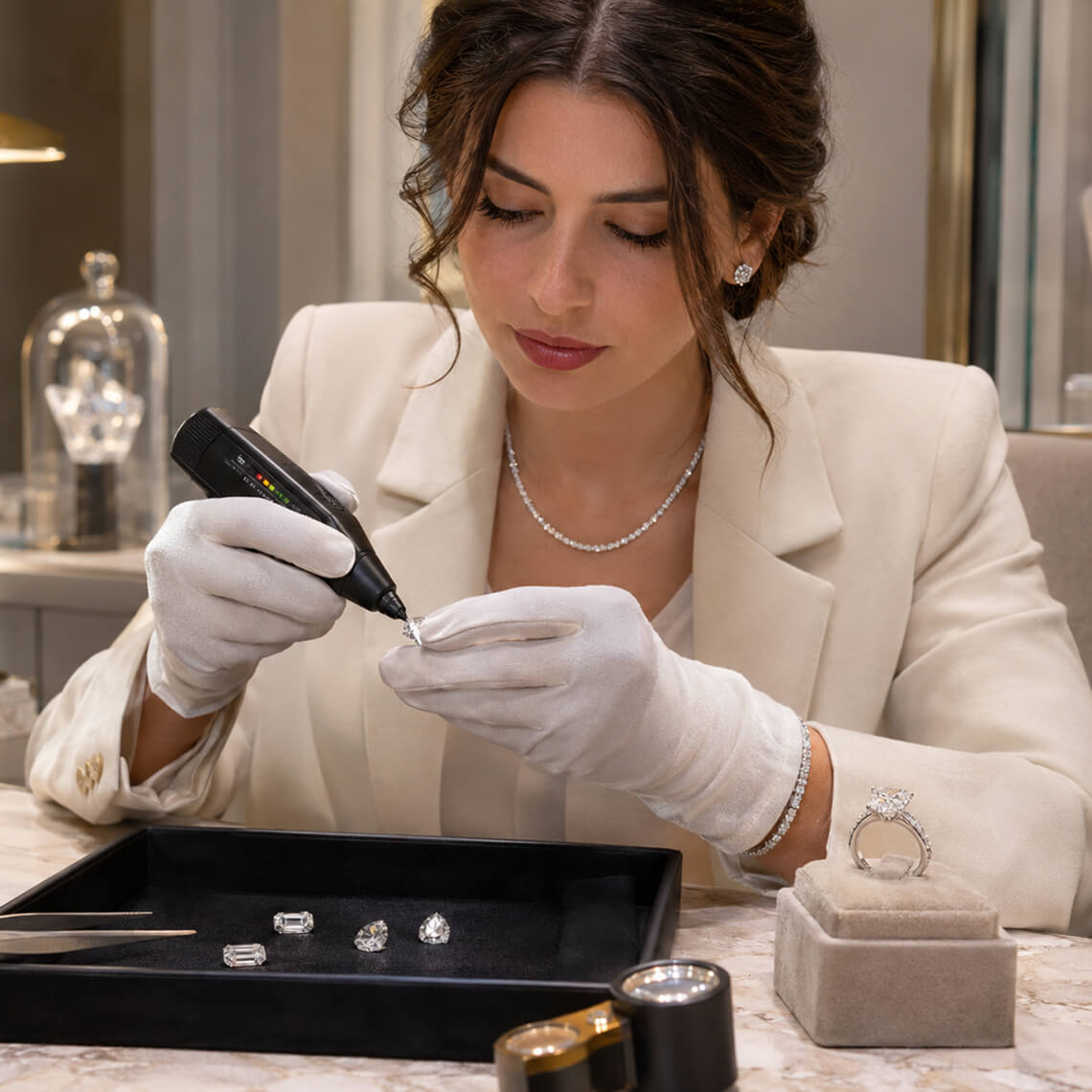
Diamond testers are compact handheld devices made specifically to identify gemstones on the basis of their physical properties. Different testing devices take different testing approaches.
Thermal Conductivity Testers
Heat moves through diamond faster than almost any other material. Thermal testers exploit this by touching a probe to the stone and measuring how quickly heat transfers. Both mined and lab-grown diamonds conduct heat in essentially the same way, so both register as diamonds on these devices.
The notable exception is moissanite. It also has high thermal conductivity, which means older thermal-only testers can misread it as a diamond. This is worth knowing before you rely on one.
Electrical Conductivity Testers
These devices measure how easily electricity passes through a stone. Because moissanite and diamond behave differently in this regard, electrical testers can help tell them apart.
The complication is that some lab-grown diamonds, particularly those grown with boron present, do conduct electricity. So electrical conductivity alone won't give you a reliable answer about a stone’s origin.
Combination Diamond Testers
Combination testers measure both thermal and electrical conductivity.
They generally offer better discrimination between diamond and moissanite than thermal-only instruments.
Even so, they experience the same problem when it comes to origin. A combination tester still cannot tell a lab-grown diamond from a mined one. Stone properties, tester design, and testing conditions can all affect the result.
Can a Diamond Tester Distinguish Lab-Grown and Natural Diamonds?
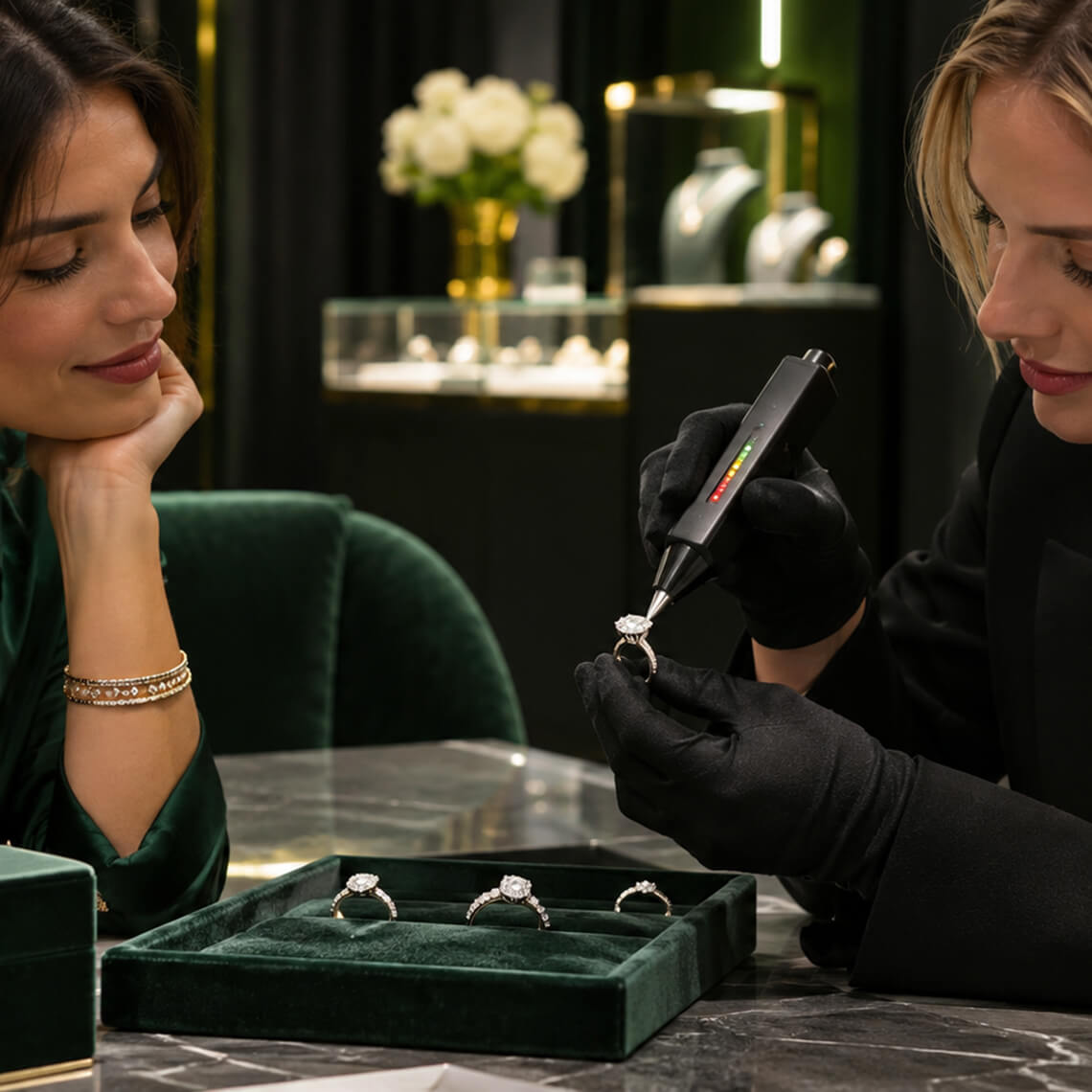
No, and this is the most important thing to understand about these devices.
Natural and lab-grown diamonds are made of the same thing: carbon atoms in the same crystal arrangement. Their optical and physical properties are, for all practical purposes, identical. The only real difference is how they came to exist.
Natural diamonds take millions of years to form through enormous heat and pressure deep within the earth. Lab-grown diamonds are manufactured using technologies like HPHT (High Pressure High Temperature) or CVD (Chemical Vapor Deposition) in a controlled environment.
These differences in the growth process often leave some traces. But again, these traces are microscopic. You need advanced equipment for thorough identification.
The GIA has been clear on this point: confirming whether a diamond is natural or lab-grown requires proper gemological examination, not a handheld tester.
Lab-Grown Diamonds vs. Natural Diamonds vs. Moissanite on a Diamond Tester
You may notice similar results on certain testers for different gemstones even if their chemical composition isn’t the same.
|
Gemstone |
Thermal tester result |
What buyers should know |
|
Natural diamond |
Generally registers as diamond |
Cannot confirm natural origin |
|
Lab-grown diamond |
Generally registers as diamond |
Cannot confirm laboratory origin |
|
Moissanite |
May register as diamond |
Combination testing can help distinguish it |
|
Cubic zirconia |
Generally does not register as diamond |
Has substantially different thermal properties |
Moissanite is particularly important in this comparison because its high thermal conductivity can confuse basic testers.
A combination tester may help identify the difference, although unusual gemstone properties can still produce misleading results.
When accurate identification matters, professional testing is the only dependable approach.
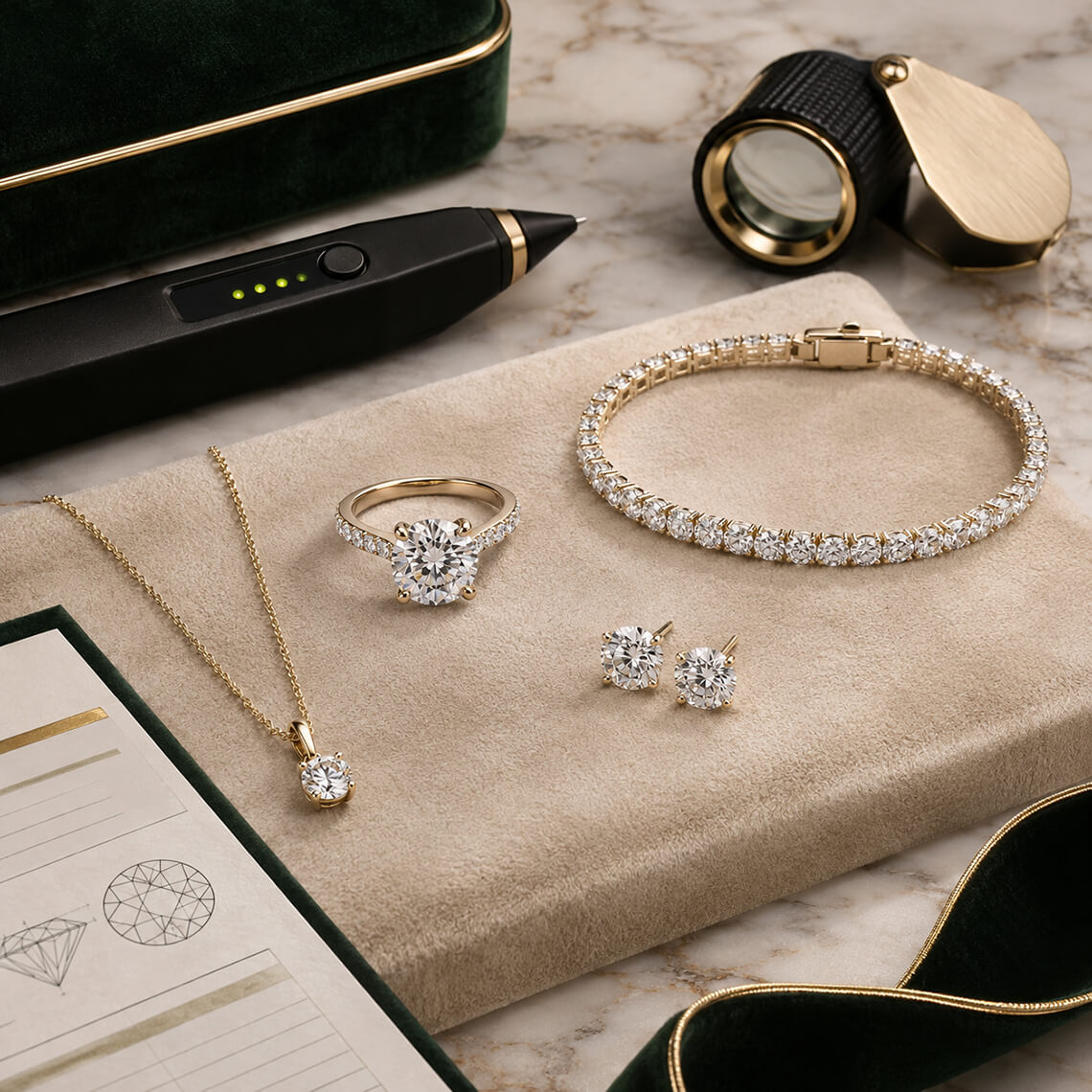
How Can You Tell If a Diamond Is Lab-Grown or Natural?
Gemologists have more than one reliable method for this, none of which involve an ordinary handheld tester.
Check the Diamond Grading Report
A report from a recognized gemological laboratory provides information about the diamond's origin and quality.
The International Gemological Institute (IGI) issues laboratory-grown diamond reports that document origin alongside the standard quality characteristics: carat weight, color, clarity and cut.
GIA has also expanded its lab-grown diamond services; since October 2025, its quality assessments for eligible colorless to near-colorless lab-grown diamonds use Premium and Standard classifications.
Always confirm which lab issued the report and what it actually covers.
Check the Laser Inscription
Some diamonds carry microscopic laser inscriptions along their girdles, the narrow outer edge separating the crown and pavilion. An inscription may include a report number or wording identifying laboratory-grown origin.
GIA's current laboratory-grown diamond assessment service includes an inscription identifying the stone as laboratory-grown.
A jeweler can examine these markings using suitable magnification.
However, don't just rely on an inscription to determine authenticity. Some stones won't have one. Others may have inscriptions that are worn, unclear, or, in rare cases, tampered with.
Use Advanced Gemological Equipment
Professional laboratories use instruments with the ability to identify a diamond's growth characteristics.
These include:
-
Spectroscopy to examine distinctive absorption or emission features.
-
Ultraviolet imaging to study fluorescence and growth patterns.
-
Advanced screening instruments to identify stones requiring further examination.
There are multiple testing techniques that help unveil the characteristics that associate a diamond’s growth with HPHT or CVD technology.
GIA makes use of advanced instrumentation such as the iD100 screening device. It helps distinguish laboratory-grown stones and simulants from natural diamonds.
Consult a Professional Gemologist
Uncertainty about a diamond’s origin should prompt you to consult a qualified gemologist or an independent gemological laboratory.
Professionals can examine the stone as well as evaluate its documentation. They can determine the need for advanced testing, too.
This matters if you wish to purchase pre-owned diamond jewelry or a stone that lacks reliable documentation.
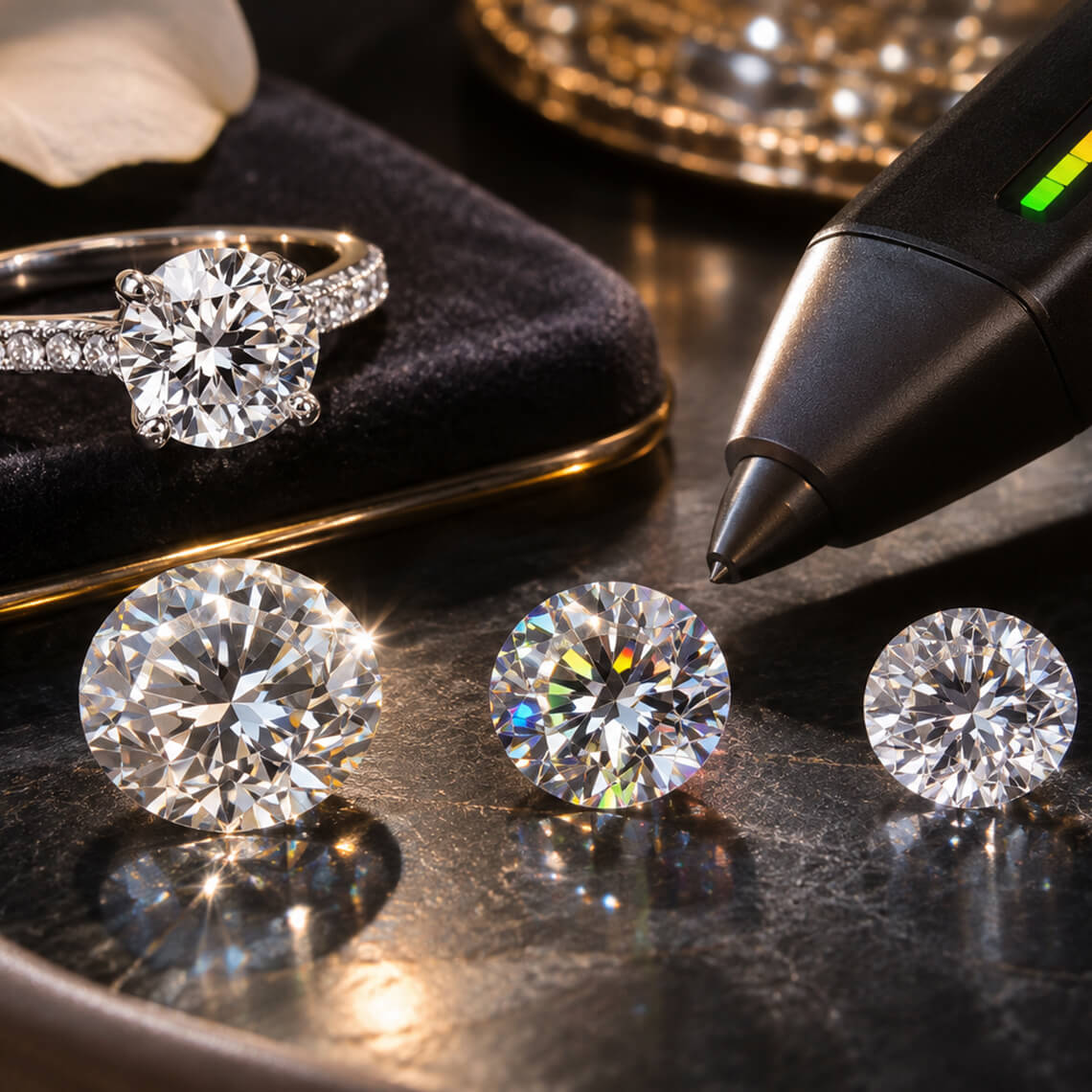
Can You Test a Lab-Grown Diamond at Home?
You can, but go in with realistic expectations. A thermal tester at home can confirm that a stone behaves like a diamond in terms of heat conductivity. It cannot tell you anything about whether that diamond grew naturally or in a lab.
Some home tests that circulate online aren't just unhelpful; they can be misleading or even damaging:
-
Fog tests: Condensation disappears at different rates depending on temperature and surface conditions.
-
Visual inspection: Lab-grown and mined diamonds generally look identical in the absence of specialized testing.
-
Water tests: A stone sinking in water does not establish that it is a diamond.
-
Scratch tests: Attempting to scratch glass or another material can damage the jewelry and proves little about authenticity.
For valuable purchases, an independent grading report offers far more useful information than these informal tests.
Why a Diamond Grading Report Matters
A test result, even a positive one, is not documented information. A grading report establishes information that basic testers cannot.
Depending on the issuing laboratory and report type, it may include:
-
Natural or laboratory-grown origin
-
Carat weight and measurements
-
Color and clarity information
-
Cut quality or finish assessment
-
Relevant growth or treatment information
-
Report identification number
Before purchasing, verify the report number directly through the issuing laboratory's website.
GIA Report Check or IGI Report Verification can help you review available report information.
Compare the diamond specifications and any laser inscription with the information in the report.
Transparent disclosure of laboratory-grown origin helps you understand exactly what you are purchasing.
Conclusion
Lab-grown diamonds pass standard diamond testers because they share the same essential properties as mined stones. A positive reading is not proof of natural origin, and it's not proof of anything beyond the stone's diamond-like thermal characteristics.
If you want a complete review of what you're buying, start with the grading report, verify the details independently, and get professional advice if anything is unclear. This combination of steps is what actually protects you as a buyer.
FAQs
Can a regular diamond tester detect lab-grown diamonds?
Can a diamond tester tell the difference between lab-grown and natural diamonds?
Do lab-grown diamonds test positive as real diamonds?
Can moissanite pass a diamond tester?
Will a lab-grown diamond pass a jeweler's diamond test?
Do lab-grown diamonds have laser inscriptions?
Can you test a lab-grown diamond at home?